


 Cart
Cart
 sales@molnova.com



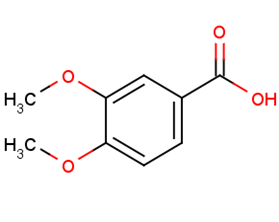
Veratric acid
CAS No. 93-07-2
Veratric acid( 3,4-Dimethoxybenzoic acid )
Catalog No. M17718 CAS No. 93-07-2
Veratric acid plays an important role in producing antibiotics and various dyes.
Purity : >98% (HPLC)
 COA
Datasheet
HNMR
HPLC
MSDS
Handing Instructions
COA
Datasheet
HNMR
HPLC
MSDS
Handing Instructions
| Size | Price / USD | Stock | Quantity |
| 100MG | 38 | In Stock |


|
| 200MG | Get Quote | In Stock |
|
| 500MG | Get Quote | In Stock |
|
| 1G | Get Quote | In Stock |
|
Biological Information
-
Product NameVeratric acid
-
NoteResearch use only, not for human use.
-
Brief DescriptionVeratric acid plays an important role in producing antibiotics and various dyes.
-
DescriptionVeratric acid plays an important role in producing antibiotics and various dyes. They are used as intermediates for pharmaceuticals (especially for antipyretic analgesic, anti-rheumatism) and other organic syntheses. It is used as a matrix for ionization of peptides, proteins, and carbohydrates.(In Vitro):Veratric acid (100, 200 μM) suppresses iNOS expression in LPS-stimulated RAW264.7 cells. Veratric acid (200 μM) inhibits LPS-induced activation of the PI3K/Akt pathway, HAT activation and HDAC3 expression in RAW264.7 cells.Veratric Acid (10-100 μg/mL) has anti-inflammatory activity, protects HaCaT cells against UVB-mediated phototoxicity, increases S-phase cells, and prevents UVB-mediated apoptosis.Veratric acid reduces upregulated COX-2 expression, and levels of PGE2, IL-6 after UVB irradiation.(In Vivo):Veratric acid (40 mg/kg, p.o., b.w.) significantly promotes ventricular function, reduces lipid peroxidation and increases antioxidants in l-NAME-induced hypertensive rats.
-
In VitroVeratric acid (100, 200 μM) suppresses iNOS expression in LPS-stimulated RAW264.7 cells. Veratric acid (200 μM) inhibits LPS-induced activation of the PI3K/Akt pathway, HAT activation and HDAC3 expression in RAW264.7 cells.Veratric Acid (10-100 μg/mL) has anti-inflammatory activity, protects HaCaT cells against UVB-mediated phototoxicity, increases S-phase cells, and prevents UVB-mediated apoptosis. Veratric acid reduces upregulated COX-2 expression, and levels of PGE2, IL-6 after UVB irradiation.
-
In VivoVeratric acid (40 mg/kg, p.o., b.w.) significantly promotes ventricular function, reduces lipid peroxidation and increases antioxidants in l-NAME-induced hypertensive rats.
-
Synonyms3,4-Dimethoxybenzoic acid
-
PathwayAngiogenesis
-
TargetVEGFR
-
RecptorOthers
-
Research AreaOthers-Field
-
Indication——
Chemical Information
-
CAS Number93-07-2
-
Formula Weight182.17
-
Molecular FormulaC9H10O4
-
Purity>98% (HPLC)
-
SolubilityIn Vitro:?DMSO : 100 mg/mL (548.94 mM)
-
SMILESCOc1c(cc(cc1)C(=O)O)OC
-
Chemical Name——
Shipping & Storage Information
-
Storage(-20℃)
-
ShippingWith Ice Pack
-
Stability≥ 2 years
Reference
1.Lee KE, et al. Arch Dermatol Res. 2016 Apr;308(3):183-92.
molnova catalog



related products
-
TIE-2/VEGFR-2 kinase...
TIE-2/VEGFR-2 kinase-IN-5 (TIE-2 and VEGFR-2 tyrosine kinase receptor inhibitor) is a potent agent with anti-angiogenic activity, commonly used in biomedical research focused on angiogenesis.
-
Tyrosine kinase-IN-1
Tyrosine kinase-IN-1 is a multi-targeted tyrosine kinase inhibitor(KDR Flt-1 FGFR1 and PDGFRα with IC50s of 4nM 20nM 4nM 2 nM respectively).
-
Nintedanib
A potent triple angiokinase (VEGFR/PDGFR/FGFR) inhibitor with IC50 of 5/38/18/104/5 nM for VEGFR-2/FGFR-1/PDGFRα/VEGFR-1/VEGFR-3, respectively.
